Calculate greenhouse gas emissions with EIME
Calculating the carbon footprint of a product consists of modeling all stages of the life cycle (raw material extraction, manufacturing, distribution, installation, use and end-of-life) to analyze the climate change indicator only.
The objective is to quantify the greenhouse gas emissions generated over the product's life cycle!
The methodology for calculating a product's carbon footprint, standardized internationally by ISO 14067, follows the following steps:
 ISO 14040, ISO 14044
-
1. Definition of objectives
After describing the context and intended application of your LCA, you will need to describe the system being studied.
To do this, you will define a
Quantified performance of a product system intended to be used as a reference unit in a life cycle assessment.
Measure of the outputs of processes in a given product system, necessary to fulfill the function as expressed by the functional unit.
In the case of a partial
Product Carbon Footprint
Quantity of a construction product intended to be used as a reference unit in an EPD for an environmental declaration based on one or more information modules (EN 15804+A2).
In order to define the scope of your study, you will determine the system boundaries.
If assumptions are made, you must list them as well as their limitations.
If
PCRs are sets of rules relating to product categories. These specific guidelines establish a methodology for assessing the environmental impact of a product or service during its life cycle.
PCRs are based on international standards such as ISO 14025 and ISO 14040.

-
2. Life Cycle Inventory (LCI)
The second step is to identify and quantify the relevant inputs and outputs of the system being studied: energy inputs, raw materials, waste, emissions to air, water, soil, etc.
A distinction between
Data collected in the field, specific to a manufacturer.
Generic data from bibliography or research work. They represent an average.
The cut-off criterion of your PCF study, commonly set at 5% of the total mass of the reference flow, energy and environmental impact, must be respected.
With EIME you will be able to use residual energy mixes, which are to be used if you consume electricity from the grid during a PCF.
-
3. Climate change impact assessment
The PCF impact assessment phase consists of associating inventory data with EIME data to reconstruct the life cycle of your product or service.
The objective is to quantify the environmental impact "Climate Change".

EIME supports you in this step:
EIME software guides you step by step in modeling the life cycle of your products and services.
EIME has so-called "configurable" data that allows you to adapt the electricity mix of a data set to a specific geographic area. These configurable data are available for manufacturing processes.
It is possible to copy/paste a folder or component from one case study to another. It is also possible to convert a case study into a system. Systems are then visible from the data library and can be added with one click to your modeling.
Modeling can introduce subjectivity in the impact assessment phase. Therefore, assumptions must be clearly described and reported in a PCF study report.
With EIME you will be directly aligned with the latest version of the IPCC (Intergovernmental Panel on Climate Change), as required by ISO 14067 standard.
-
4. Interpretation of results and PCF communication
Finally, you must provide a understandable, complete and consistent presentation of PCF results, in accordance with the objectives and scope of the study.
The objectives are:
- to identify significant environmental aspects,
- to identify improvement opportunities,
- to formulate recommendations to decision-makers (sensitivity analysis).
Possibly, the interpretation phase may lead to a revision of the nature and quality of the data collected.
EIME supports you in this step:
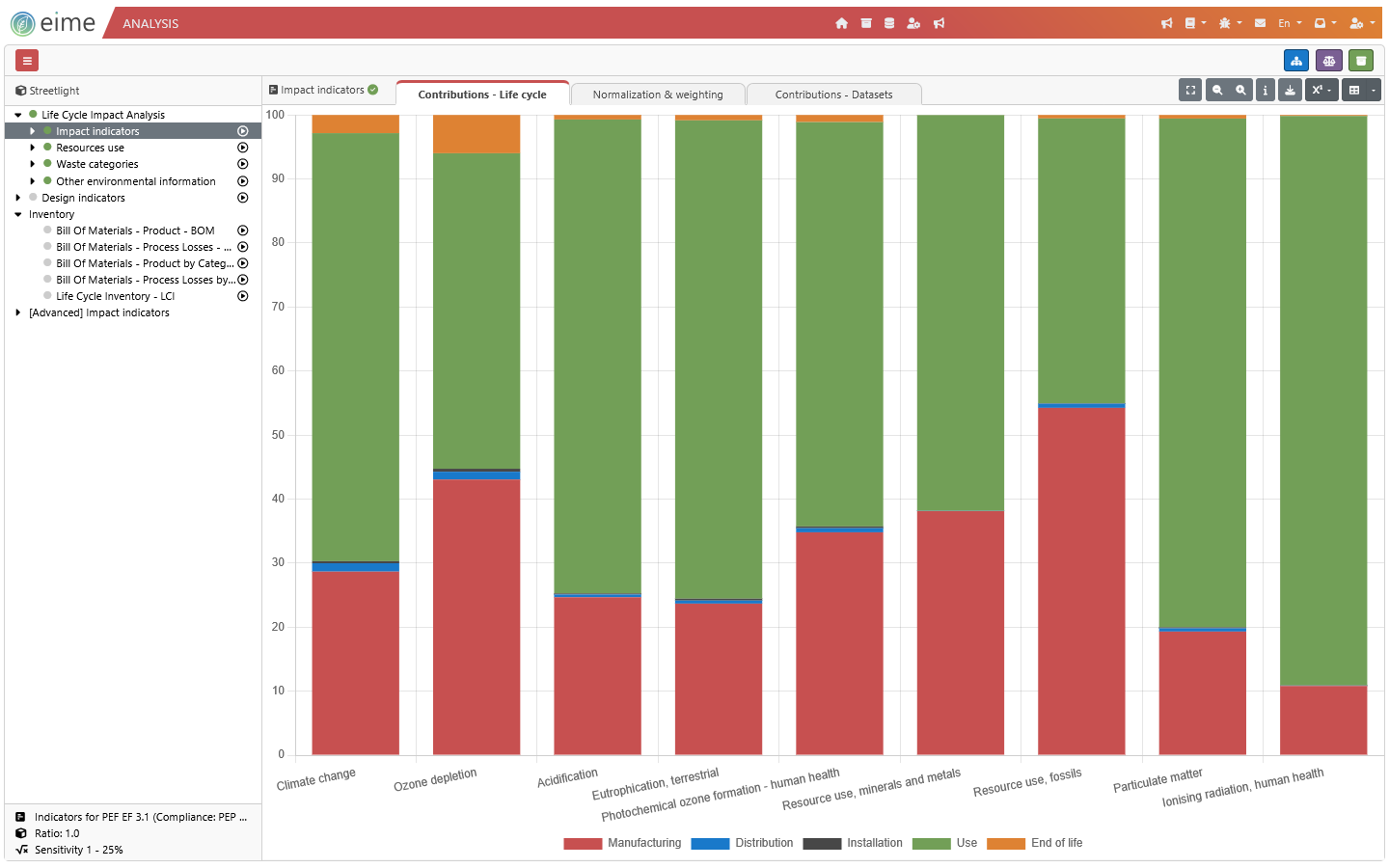
EIME will allow you to separate emissions: aviation, biogenic, fossil, land use and sequestration as required by ISO 14067 standard.
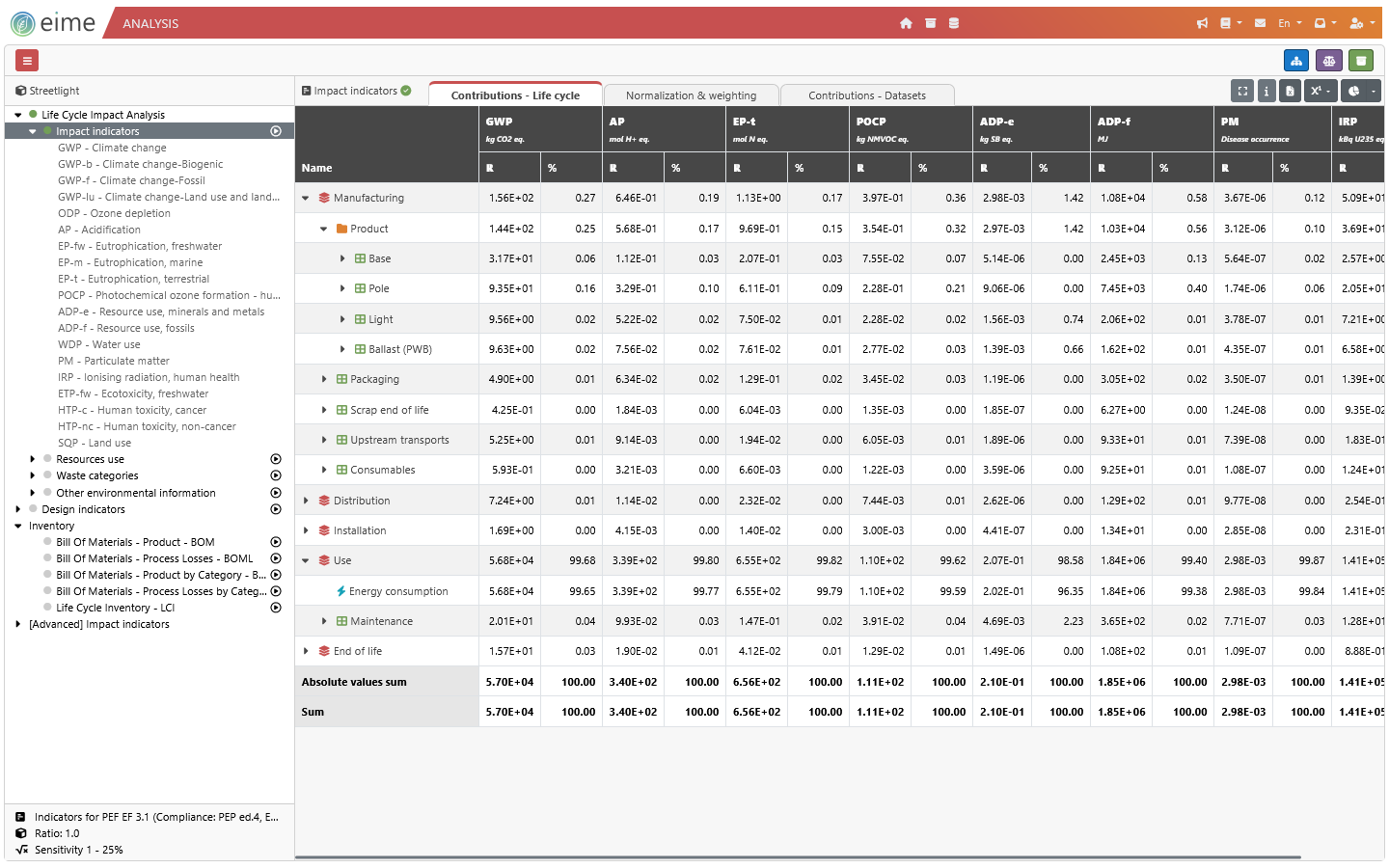
All analysis results are exportable in a single Excel file. You will find all calculated indicators (impacts, resources, waste, etc.), the various material balances as well as the life cycle inventory (LCI).
Each result table can also be downloaded individually while preserving the display settings defined in the software.
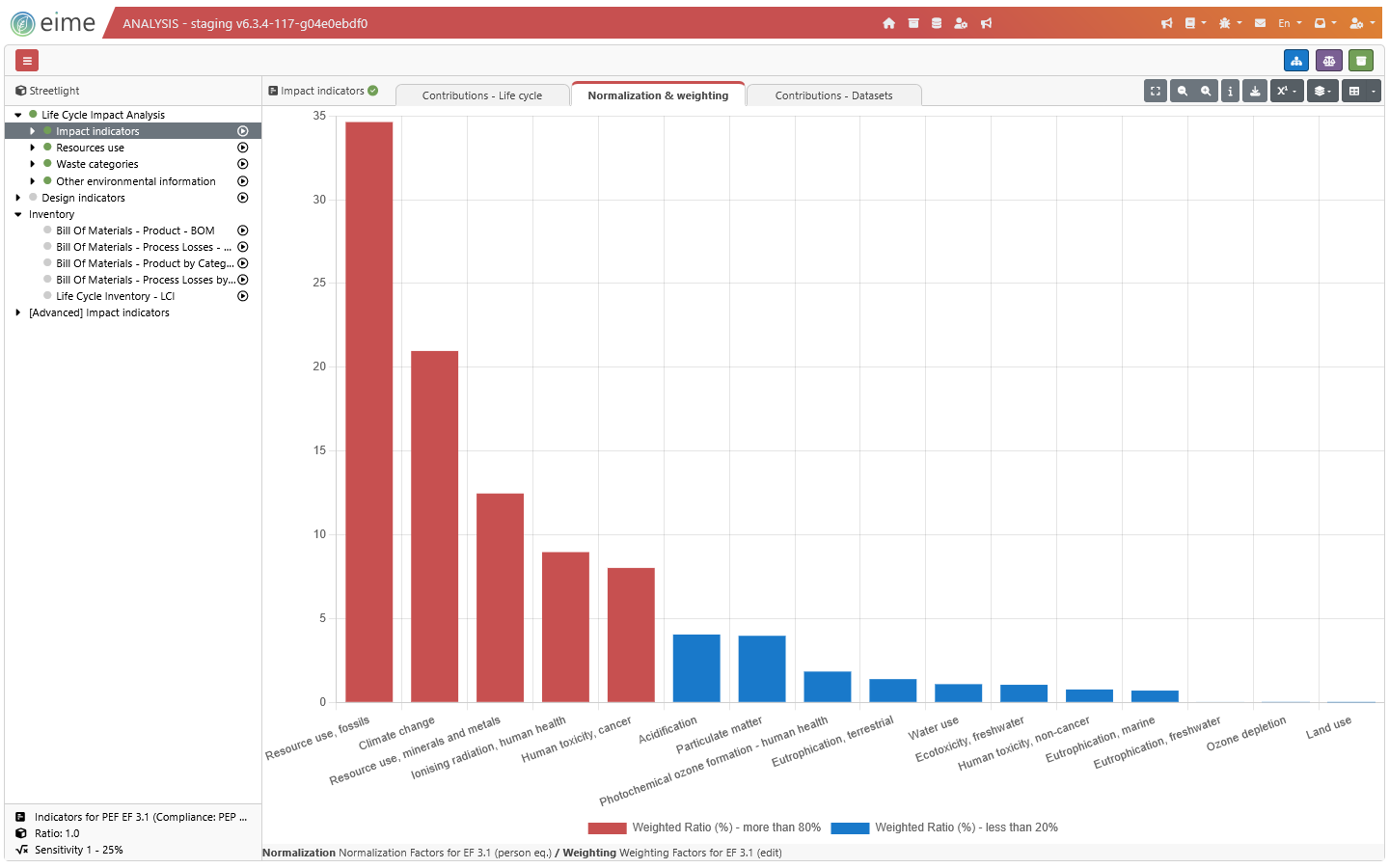
EIME allows you to export all graphical elements in PNG format.
-
1. Definition of objectives
After describing the context and intended application of your LCA, you will need to describe the system being studied.
To do this, you will define a
Quantified performance of a product system intended to be used as a reference unit in a life cycle assessment.
Measure of the outputs of processes in a given product system, necessary to fulfill the function as expressed by the functional unit.
In the case of a partial
Product Carbon Footprint
Quantity of a construction product intended to be used as a reference unit in an EPD for an environmental declaration based on one or more information modules (EN 15804+A2).
In order to define the scope of your study, you will determine the system boundaries.
If assumptions are made, you must list them as well as their limitations.
If
PCRs are sets of rules relating to product categories. These specific guidelines establish a methodology for assessing the environmental impact of a product or service during its life cycle.
PCRs are based on international standards such as ISO 14025 and ISO 14040.
-
2. Life Cycle Inventory (LCI)
The second step is to identify and quantify the relevant inputs and outputs of the system being studied: energy inputs, raw materials, waste, emissions to air, water, soil, etc.
A distinction between
Data collected in the field, specific to a manufacturer.
Generic data from bibliography or research work. They represent an average.
The cut-off criterion of your PCF study, commonly set at 5% of the total mass of the reference flow, energy and environmental impact, must be respected.
With EIME you will be able to use residual energy mixes, which are to be used if you consume electricity from the grid during a PCF.
-
3. Climate change impact assessment
The PCF impact assessment phase consists of associating inventory data with EIME data to reconstruct the life cycle of your product or service.
The objective is to quantify the environmental impact "Climate Change".
EIME supports you in this step:
EIME software guides you step by step in modeling the life cycle of your products and services.
EIME has so-called "configurable" data that allows you to adapt the electricity mix of a data set to a specific geographic area. These configurable data are available for manufacturing processes.
It is possible to copy/paste a folder or component from one case study to another. It is also possible to convert a case study into a system. Systems are then visible from the data library and can be added with one click to your modeling.
Modeling can introduce subjectivity in the impact assessment phase. Therefore, assumptions must be clearly described and reported in a PCF study report.
With EIME you will be directly aligned with the latest version of the IPCC (Intergovernmental Panel on Climate Change), as required by ISO 14067 standard.
-
4. Interpretation of results and PCF communication
Finally, you must provide a understandable, complete and consistent presentation of PCF results, in accordance with the objectives and scope of the study.
The objectives are:
- to identify significant environmental aspects,
- to identify improvement opportunities,
- to formulate recommendations to decision-makers (sensitivity analysis).
Possibly, the interpretation phase may lead to a revision of the nature and quality of the data collected.
EIME supports you in this step:
EIME will allow you to separate emissions: aviation, biogenic, fossil, land use and sequestration as required by ISO 14067 standard.
All analysis results are exportable in a single Excel file. You will find all calculated indicators (impacts, resources, waste, etc.), the various material balances as well as the life cycle inventory (LCI).
Each result table can also be downloaded individually while preserving the display settings defined in the software.
EIME allows you to export all graphical elements in PNG format.